
The Logistics Bottleneck: How Parking Scarcity Sabotages Dispatch and Compliance
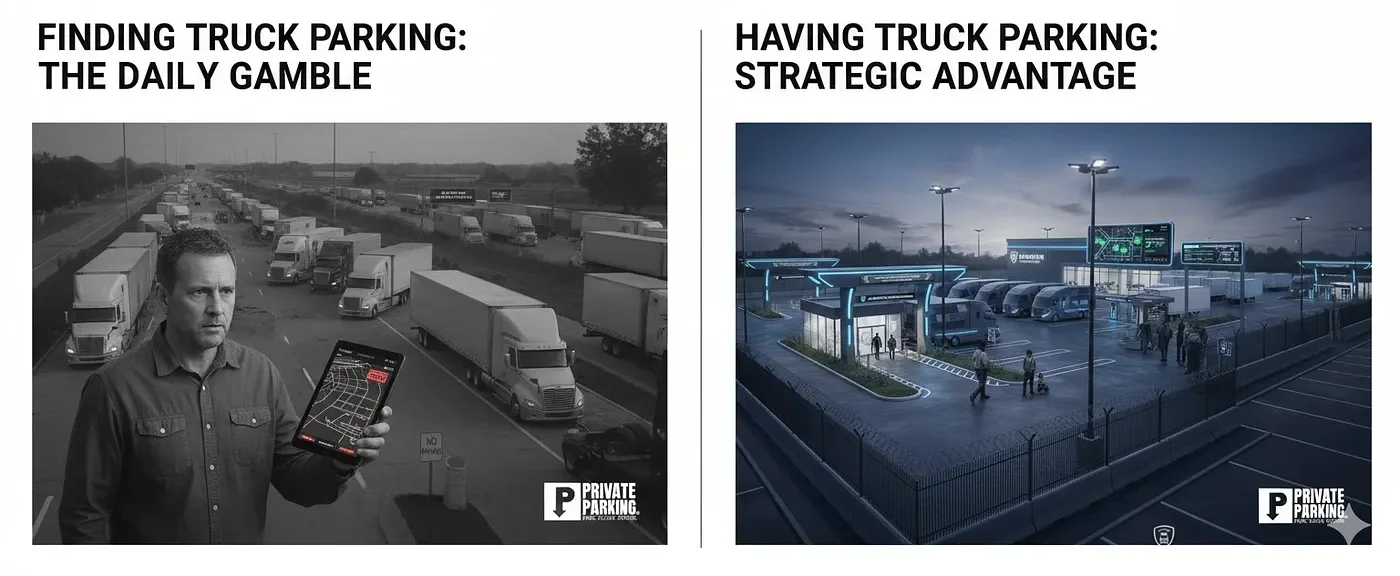
In the high-stakes world of just-in-time logistics, the “last mile” is often discussed, but the “last hour” — the final sixty minutes of a driver’s legal service day — is where the most expensive failures occur.
As supply chains become more rigid, a quiet crisis is brewing at the edge of the interstate. What appears to be a simple lack of pavement is actually a primary driver of dispatch volatility and regulatory risk. When a driver cannot find a place to stop, the ripple effect moves upward through the organization, turning a parking problem into a corporate compliance disaster.
The Domino Effect on Hours of Service (HOS)
For dispatchers, a driver’s HOS clock is a finite resource, as rigid as any physical inventory. Parking uncertainty introduces a “phantom variable” that makes accurate planning impossible.
• The “Safety Buffer” Tax: To avoid violations, cautious dispatchers often build 60 to 90 minutes of “parking search time” into a route. This represents a massive underutilization of assets. In a fleet of 500 trucks, losing an hour of productivity per day is equivalent to having dozens of trucks sitting idle for an entire year.
• The Forced Violation: When a driver reaches their 11-hour driving limit and the nearest “safe” lot is full, they face an impossible choice: park illegally on a dangerous shoulder or “push the clock” to the next exit. In 2026, with real-time ELD (Electronic Logging Device) monitoring, these forced violations trigger immediate alerts that require hours of back-office mitigation and increase the fleet’s risk profile during DOT audits.
Dispatcher Burnout and Resource Drain
The modern dispatcher is intended to be a logistics architect, optimizing routes and managing customer relationships. Instead, parking scarcity has turned them into “parking concierge” services.
• Reactive Management: When a driver is stuck in a full lot, the dispatcher must drop high-value tasks to manually search for alternatives, call local facilities, or reroute other drivers. This “firefighting” mode prevents the strategic planning necessary for fleet growth.
• The Communication Cascade: One parking failure rarely stays localized. A driver who oversleeps due to a late-night parking hunt misses a morning appointment, which delays the next load, which creates a late delivery for a key account. A single full lot in Ohio can effectively derail a three-day schedule for a truck headed to the West Coast.
The “Reliability Gap” in Customer Service
In the eyes of the shipper, the reason for a late delivery is irrelevant; only the delay matters. Parking uncertainty is the primary cause of the “Reliability Gap.”
• Late-Arrival Penalties: Major retailers increasingly levy hefty fines for missing appointment windows. If a driver has to stop 40 miles short of a destination because that was the last available spot, they may not be able to bridge that gap in time for an early-morning dock time the next day.
• Cargo Vulnerability: When dispatchers are forced to approve “emergency” parking in unsecured areas, the risk of theft skyrockets. A “safe” delivery that arrives 12 hours late because the driver had to wait for a secure spot is often better than a load that never arrives at all — but neither is ideal for the bottom line.
Conclusion: From Real Estate to Risk Management
The industry can no longer view truck parking as a real estate issue or a “driver problem.” It is a structural risk to operational integrity. Fleets that move toward reserved, guaranteed parking models aren’t just buying space; they are buying compliance insurance and dispatch predictability.
In the competitive landscape of 2026, the fleets that thrive will be those that realize the most expensive parking spot in the country is the one that isn’t there when the clock hits zero.
