
Why Truck Stops Can’t Solve the Fleet Parking Crisis
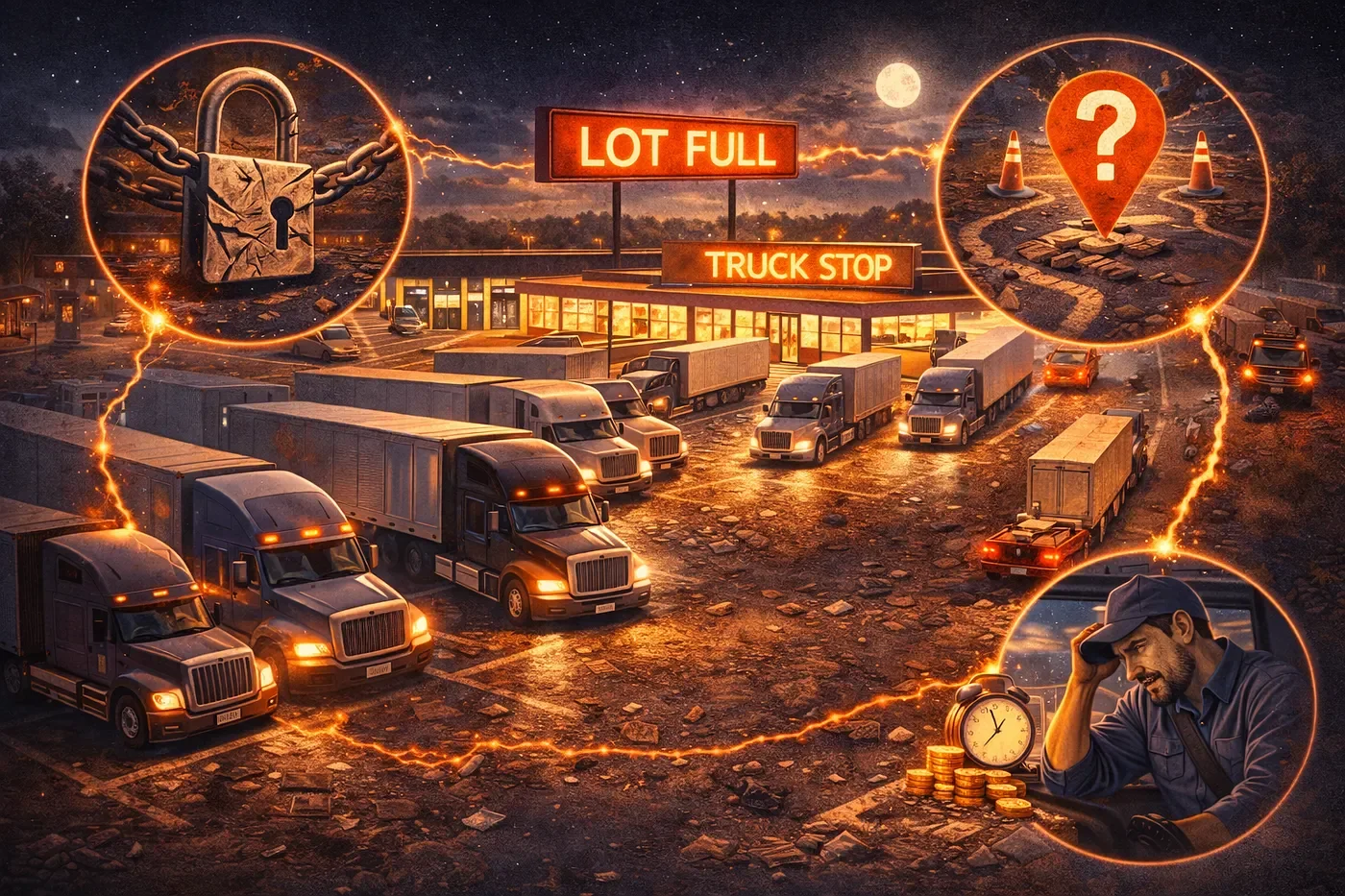
Structural limits in the truck stop model leave fleets facing a problem it was never designed to fix.
For decades, truck stops have been treated as the default answer to one of the freight industry’s most basic needs: where trucks go when the day ends. They are visible, familiar, and deeply woven into the culture of American trucking.
But as fleet operations have grown more complex and freight volumes have increased, that assumption has begun to break down.
Truck stops were not designed to support modern fleet parking at scale. And no amount of incremental expansion is likely to change that.
A Model Built for Individuals, Not Systems
Truck stops emerged to serve individual drivers moving independently across long distances. Their design reflects that purpose: first-come, first-served parking; short dwell times; constant turnover.
Fleet operations work differently.
They require predictability. Dispatchers need to know where equipment will be staged. Drivers need certainty about where they will stop before hours-of-service limits become binding. Safety teams need assurance that parking decisions do not introduce unnecessary risk.
The truck stop model offers none of that by default. Availability is uncertain. Access varies by location and time of day. Overnight capacity is routinely exceeded in high-traffic corridors.
For fleets, parking becomes a nightly improvisation rather than a planned input.
Capacity That Cannot Scale With Demand
Freight demand in the United States has grown steadily, but truck stop capacity has not kept pace. Building new locations is expensive, land-intensive, and often constrained by zoning and community resistance.
Even where truck stops do exist, their footprint is finite. Parking lots fill early in the evening, particularly near major urban centers and intermodal hubs. Once full, there is no mechanism to allocate space based on operational need.
The result is predictable congestion — and predictable spillover into public streets, highway ramps, and unofficial spaces never meant for overnight parking.
Truck stops are absorbing pressure they were never engineered to handle.
Misalignment With Fleet Compliance Needs
Modern compliance frameworks assume that drivers can stop safely and legally when required. In practice, that assumption often fails at truck stops.
A driver arriving late to a full facility faces limited options: continue driving in search of space, park illegally nearby, or stop in an unsecured area. Each option carries risk.
From a fleet perspective, this turns compliance into a variable outcome rather than a controlled process. Violations, citations, and fatigue-related issues are downstream consequences of parking uncertainty — not driver intent.
Truck stops do not offer fleets the ability to manage this risk proactively.
Safety Is Treated as Secondary
Truck stops prioritize throughput. They are busy by design. High foot traffic, constant vehicle movement, and open access are features of the model.
For overnight fleet parking, those same features can become liabilities.
Lighting, access control, and separation between parked equipment and public areas vary widely. Theft, vandalism, and driver safety concerns are not uncommon, particularly in oversaturated locations.
For fleets responsible for both people and equipment, this inconsistency matters. Safety is not something that can be addressed incident by incident; it must be built into the parking environment itself.
An Infrastructure Gap, Not an Operational Failure
The ongoing reliance on truck stops to solve fleet parking is not a failure of execution. It is a mismatch of purpose.
Truck stops are optimized for fueling, food, and short stays. Fleets need parking that functions as infrastructure — predictable, secure, and integrated into operational planning.
As freight continues to move through denser corridors and tighter delivery windows, the gap between what truck stops offer and what fleets require will only widen.
Solving the fleet parking crisis will require acknowledging a simple reality: the system long treated as the solution was never designed for the problem it is now expected to carry.
